What to Expect During Student Teaching: A Practical Guide
Student teaching is where teaching stops being theoretical.
You can understand lesson planning, classroom management, assessment, and differentiation in a college course. That does not mean you are ready to do all of them at the same time with a room full of students looking to you for what happens next.
I had several student teachers in my classroom over the years. Every one of them told me they learned more about the day-to-day reality of teaching once they were actually in the classroom than they had in college.
Planning was a big one. Content knowledge was another.
They might understand the material well enough to complete an assignment themselves, but teaching it was different. Suddenly they had to explain an idea clearly, answer questions they had not expected, figure out why a student was confused, and decide what to do when the first explanation did not work.
That is where student teaching earns its keep.
It is not supposed to prove that you are already a finished teacher. It is supposed to give you a place to become one.
You probably will not feel ready
A lot of student teachers start their placement and immediately think, “I am not ready for this.”
They may be right.
That is okay.
You are not supposed to walk into student teaching already knowing how to run a classroom by yourself. If you could already do that, there would not be much point in student teaching.
College can make the pieces of teaching look separate. You write lesson plans, study management, learn about assessment, and take content courses. Then you enter a classroom and discover that all of those things happen at the same time.
You may be teaching fractions while watching the clock, redirecting two students, answering a question from yesterday, helping someone who cannot find a pencil, thinking about tomorrow, and realizing that half the class misunderstood your directions.
That is not a sign that you chose the wrong profession. That is the job becoming real.
Responsibility should increase gradually
A good student-teaching placement should not begin with your cooperating teacher handing you the keys and disappearing.
At first, watch carefully. Learn the schedule, students, routines, curriculum, behavior expectations, and the thousand little things that keep the day moving.
Then start doing pieces of the job. Teach a warm-up. Work with a small group. Take over one subject. Run a transition. Plan and teach a full lesson.
Over time, you take on more responsibility.
Eventually, many programs expect student teachers to assume most or all of the teaching responsibilities for a period of time. The exact timeline varies by program and placement, but gradual release makes sense because there is a huge difference between watching someone manage a classroom and being the person responsible for managing it.
For one current example, West Chester University’s Mentor Teacher Guide describes mentor teachers adding responsibilities as candidates are ready. That is one program’s model, not a universal timeline.
What does a full takeover actually mean?
“Full takeover” sounds terrifying when you first hear it.
In many placements, it means you become the primary teacher for most or all of the instructional day. You may be responsible for planning, teaching, transitions, assessment, routines, and everyday instructional decisions.
Your cooperating teacher should still be there to support you.
Full takeover should not mean, “Good luck. See you in eight weeks.”
You should still be getting feedback, asking questions, discussing lessons, and getting help when you need it. The difference is that you are doing much more of the work.
That is the point.
Planning is harder when the lesson is real
College lesson plans can be incredibly detailed. Everything looks neat on the page.
Then you teach the lesson.
The students do not remember yesterday’s skill. The activity that was supposed to take fifteen minutes takes thirty-five. Three students finish immediately. Five have no idea what to do. Someone asks a question that exposes a gap in your own understanding.
That is real planning.
Planning is not just deciding what you are going to teach. You also need to know what students already understand, what they are likely to misunderstand, how long something will realistically take, and what you will do when the lesson goes sideways.
You get better at this by doing it.
The student teaching lesson-planning guide goes further into building objectives, timing, learning evidence, supports, and checks for understanding.
Content knowledge matters more than you think
This was one of the biggest weaknesses I saw with student teachers.
Knowing enough content to complete an assignment is not the same as knowing enough content to teach it.
Teaching exposes the difference quickly.
A student asks why something works. Another solves it using a method you did not expect. Someone gives you a wrong answer that sounds almost right. Now you have to figure out what they misunderstood.
That takes deeper content knowledge.
You need to be able to explain an idea more than one way. You need to recognize common mistakes. You need examples that make sense. You need to know what students must understand before today’s lesson will make sense.
This is especially noticeable in math. You may know how to get the answer, but teaching requires you to understand why the method works and how to explain it to someone who does not see what you see.
Prepare for that. Work through the lesson before you teach it. Read ahead. Look at the examples. Think about likely questions.
If there is something you do not understand well enough to explain, learn it before you are standing in front of the class.
There is no shame in that. Experienced teachers look things up too.
Classroom management feels different when you are the teacher
Reading about classroom management is useful. It is nothing like managing an actual classroom.
You will have moments when several things go wrong at once. Students are talking, someone is out of their seat, another student cannot find the assignment, two kids are arguing, and you are halfway through giving directions.
That is when you start learning that management is not mostly about having the perfect consequence system.
A lot of it is routines.
Students need to know how class starts, how materials are handled, what happens when they finish, how they ask for help, what voice level is expected, and what transitions look like.
Students usually do better when they know what is supposed to happen. Getting an entire class to actually do it takes practice.
The classroom management guide for student teachers takes a closer look at routines, directions, boundaries, and gradual takeover.
Directions will humble you
You are going to give directions that seem perfectly clear.
Then somebody will ask, “What are we doing?”
Another student will ask what page.
Someone else will start working with a partner even though you never mentioned partners.
This happens to experienced teachers too.
Sometimes the students were not listening. Sometimes your directions were not nearly as clear as you thought they were. Learn to tell the difference.
Keep directions short. Give them in order. Show students what you mean when possible. Check that they understand before everyone starts.
Getting better at directions saves a ridiculous amount of classroom time.
Watch what happens between lessons
Student teachers naturally pay attention to instruction. Pay attention to everything else too.
Notice how your cooperating teacher gets students settled without turning it into a fifteen-minute production. Watch how materials get distributed. See what happens when a student is absent, an assignment is missing, the technology dies, or the schedule suddenly changes.
Listen to how your cooperating teacher talks to parents. Pay attention to what gets documented and what does not. Watch how they decide which problems need immediate attention and which ones can wait.
Those small decisions are a huge part of teaching.
Nobody writes a twenty-page college paper about what to do when the copier jams ten minutes before class.
You still need to know what to do.
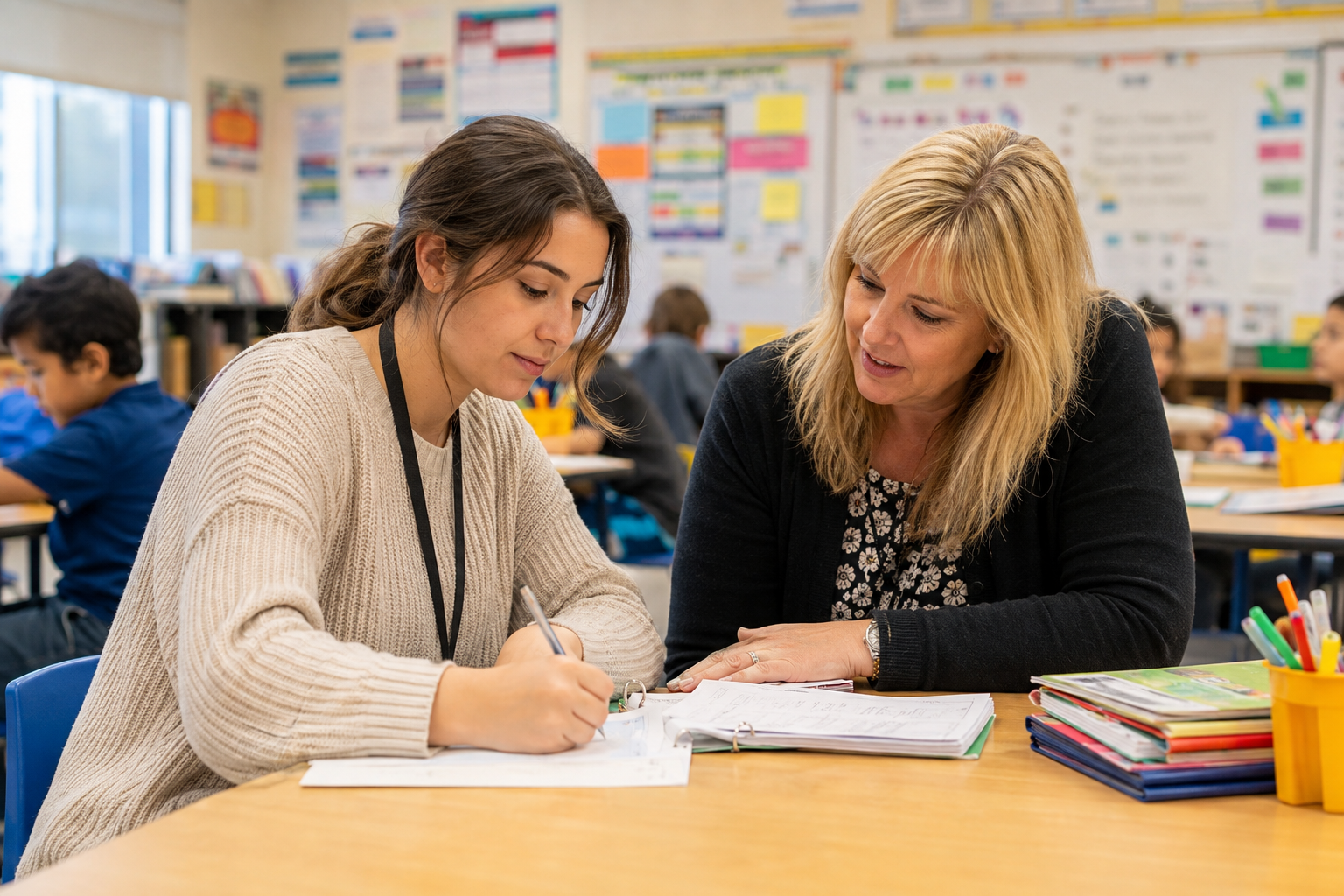
Your cooperating teacher should actually teach you
A cooperating teacher should do more than observe you and fill out forms.
They should help you improve.
Ask why they do things a certain way. Ask what they saw during your lesson. Ask what you should change tomorrow.
If something went badly, talk about it.
The best feedback is often very specific. Maybe your directions were too long. Maybe you moved on before enough students understood. Maybe you knew the content but made the explanation harder than it needed to be.
That kind of feedback can sting.
It is also useful.
Do not spend student teaching trying to prove that every decision you made was justified. Listen, think about it, and try something different.
The cooperating teacher guide covers expectations, planning, feedback, and professional boundaries in more detail.
You will screw things up
You will forget something. You will explain something badly. You will run out of time.
A lesson you thought was great will bomb. An activity you almost threw together will work beautifully.
Students may behave perfectly for your cooperating teacher and suddenly lose their minds when you take over.
Do not make every bad lesson a referendum on whether you should become a teacher.
Figure out what happened and change something.
That ability matters far more than pretending every lesson went well.
Use the observation period
Do not spend your first week sitting quietly in the back of the classroom trying to look professional.
Use the time.
Learn how the schedule actually works. Find out which students struggle and which parts of the curriculum usually cause problems. Ask how grading, missing work, behavior, and parent communication are handled.
Pay attention to why students sit where they sit and what usually goes wrong during transitions.
You are building a map of the classroom before you have to drive it.
The first-week student teaching guide can help you use that observation period well.
You may feel less confident after you start
This is one of the strange things about student teaching.
You can enter feeling fairly confident and two weeks later feel like you know nothing.
That does not necessarily mean you are getting worse. You are beginning to understand how complicated the job actually is.
Before student teaching, differentiation is a concept. Now you have actual students sitting in front of you who understand the same lesson at completely different levels.
Before student teaching, checking for understanding is something you put in a lesson plan. Now you have to decide whether the class understands enough to move on.
Before student teaching, classroom management is something you discuss. Now somebody is throwing a pencil while you are trying to teach long division.
The job becomes real.
That can shake your confidence. It can also make you much better.
College cannot completely prepare you for this
I do not think teacher-preparation programs are useless. That is not the point.
There are parts of teaching that are extremely difficult to learn until you are responsible for real students.
The student teachers I worked with discovered that very quickly. Planning, content knowledge, classroom management, pacing, and explaining ideas clearly all felt different once actual students were depending on them.
That is exactly what student teaching should expose.
Finding gaps does not mean the placement is going badly. It gives you a chance to work on those gaps while an experienced teacher is still standing beside you.
The goal is not to arrive ready
The goal is to leave ready enough to start.
Do not spend your placement hiding what you do not know.
Ask questions. Study the content you are weak in. Practice your explanations. Listen to feedback. Pay attention when a lesson falls apart and try again.
You have an experienced teacher beside you right now.
Use that opportunity.
Once you have your own classroom, there will be plenty of days when nobody is standing beside you.
For the rest of the cluster, visit Student Teaching Survival.
For a sample gradual-release timeline, read Student Teaching Week by Week. Use it as a planning model, not a replacement for your program’s required schedule.
