How to Fix Noisy Transitions in the Classroom (From a Teacher Who Has Lived Through Hundreds of Them)
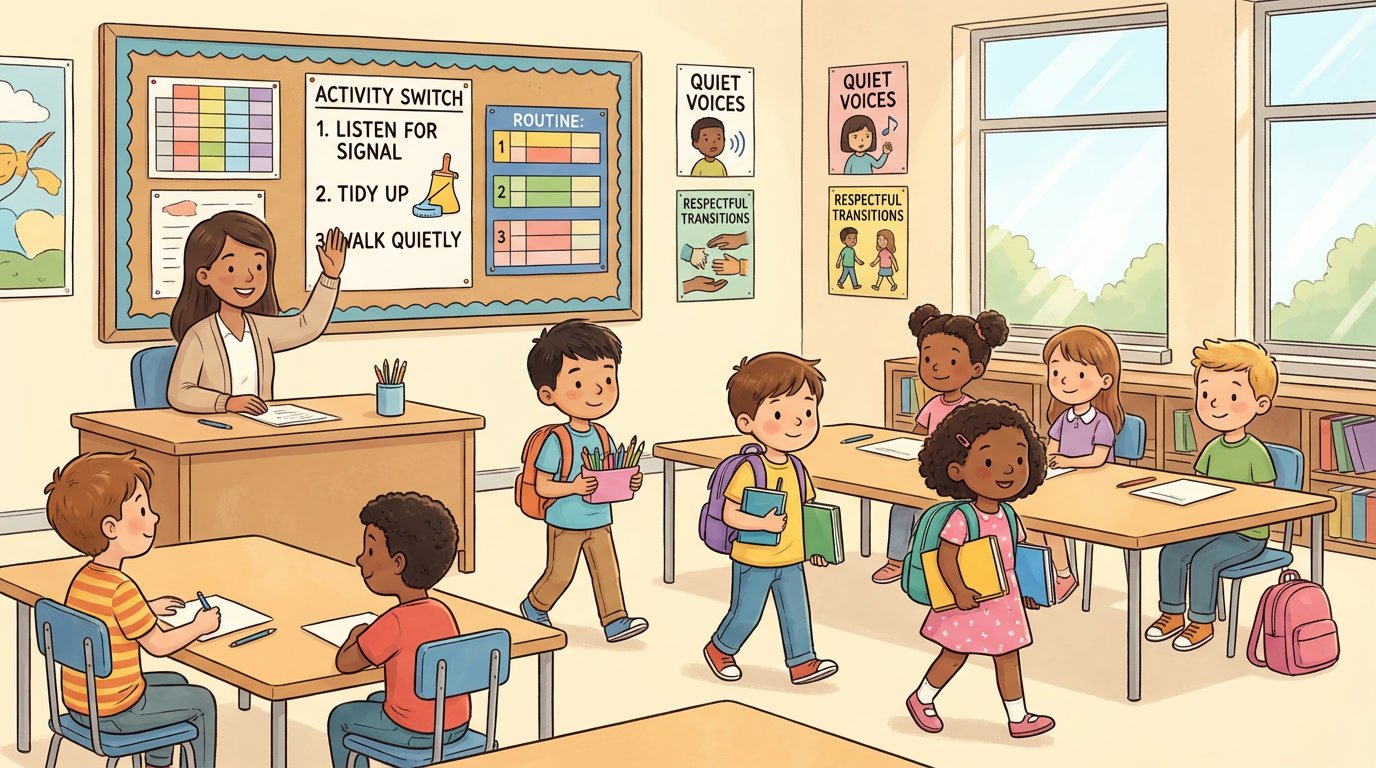
You know the moment. One second the room is focused, pencils moving, kids actually working. You give the signal to switch activities, and instantly it’s like someone hit the “loud” button. Chairs scrape. Conversations explode. A kid who has been silent for twenty minutes suddenly has something critically important to tell the entire table. Someone is wandering. Someone else is staring at the ceiling. The smooth lesson you planned turns into background noise behind thirty kids shifting around like they’re in a mall food court.
I have been teaching for more than twenty years, and I wish I could tell you that with enough experience, transitions begin to behave themselves. They do not. Not naturally. Not in any grade I’ve taught.
What does change is your system. Once that tightens up, the noise almost always goes down.
A classroom transition is the short bridge from one learning task, location, or grouping to the next. Smooth classroom transitions do not have to be perfectly silent. They do need to be predictable enough that students can move, manage materials, and begin the next task without losing the lesson. That broader goal matters: a routine that controls noise but leaves half the class unsure what to do is not actually working.
This whole idea that noisy transitions are a sign of disrespect is something a lot of new teachers believe. I remember believing it too. I once had a fifth grade class that would be quiet enough to hear a pencil drop during a read-aloud, but the moment I said, “Switch to math,” it was like a race to see who could talk first. I took it way too personally.
Eventually I realized it had nothing to do with respect. It was simply a lack of structure.
Kids are not trying to cause chaos. They just slide into it when the boundaries are wide open.
Why Transitions Get Loud (And It’s Not Because Kids Are “Being Bad”)
After all these years, here’s what I’ve learned.
1. Students don’t know exactly what to do during movement.
When kids get up, their brains shift to “physical mode,” and everything else becomes background. It’s like asking someone to solve a math problem while they’re jogging. Teachers often give instructions while kids are halfway standing. They never hear it.
2. There is no actual routine.
“Put your stuff away and switch groups” is not a routine. It’s a wish.
3. Movement = social temptation.
The second a student stands up, the part of their brain that wants to talk to friends wakes right up.
4. Teachers talk too much during the transition.
This was my biggest mistake early on. Kids cannot listen and move at the same time. If you are giving instructions while they are moving, you will lose every time.
Transitions also break down when the physical plan creates a traffic jam. If everyone needs the same bin, doorway, Chromebook cart, or sink, even students who are following directions will end up waiting and talking. Before correcting behavior, look at the route, the materials, and whether every student knows where to go and what to pick up.
Want to build a routine for a specific transition? Use the Transition Routine Builder to work through the signal, movement, materials, expectations, and reset.
The Routine That Solved 90 Percent of My Transition Problems
Here’s what actually works. I learned this the hard way, through trial, error, and five years of teaching back-to-back classes in a room with desks so close together that I had to turn sideways to get through rows.
Think of this as a small script you teach like a procedure.
Step 1: Give all instructions before anyone moves.
Say something like:
“When I say go, you will walk to your writing station, take out your journal, and start the prompt. You have ten seconds. Wait for my signal.”
That phrase “when I say go” saves you a thousand headaches. Kids freeze long enough to actually hear what you want.
This is the heart of giving effective directions: name the destination, materials, noise level, time limit, and first task while everyone is still listening. Then release the class.
Step 2: Use a single, consistent signal.
A chime.
A quiet “go.”
A countdown.
A raised hand.
Doesn’t matter, as long as it is the same every time.
Kids love consistency more than they will ever admit.
Step 3: State the sound expectation.
For example:
“This is a silent transition.”
Or “This switch should be quiet so everyone can hear the next part.”
Kids need to know the volume level. Otherwise they assume medium-loud is acceptable.
Step 4: Keep transitions short.
Timers work wonders.
Younger grades need somewhere between 10 and 20 seconds.
Upper elementary does well around 15 to 25 seconds.
Middle school can handle 20 to 30 seconds, but they will stretch it if you let them.
A timer changes everything. Even the talkers pay attention when a clock is running.
Step 5: Practice the transition like it’s a skill.
No lectures.
No guilt.
No pulling names.
Just say, “Let’s try that again. We can do it quicker.”
Kids will take practice far better than correction. The room resets much faster too.
That teach-model-practice approach is also central to this practical guide to classroom procedures for the first days of school.
Teach the routine when the class is calm. Model it once, ask students to name what success should look and sound like, practice it, and give a brief, neutral retry if needed. Later, rehearse the one step that is slipping instead of turning every mistake into a full-class lecture. That keeps practice procedural rather than punitive.
Step 6: Plan the materials and the traffic.
Decide who moves, what they carry, and which path they use. A material manager, supplies placed at more than one location, or releasing one table at a time can prevent the bottleneck that makes a transition noisy. In a tight room, the best classroom transition strategy may be a better traffic pattern rather than another reminder to be quiet.
How This Looks in Different Grades
I’ve taught fourth, fifth, and eighth grade. I’ve also covered enough first grade and kindergarten classes to know that they operate under their own laws of physics. Here’s how transitions shift across ages.
K–2
They need visual cues.
Pictures.
Arrows on the floor.
Modeling.
Lots of upbeat praise.
For little ones, transitions are almost a dance routine. Keep directions simple and physical. “When I say go, stand up, push in your chair, walk to the carpet, sit with quiet hands.”
They will need to practice. A lot. That’s normal.
3–5
Timers work best here.
So does a little friendly competition.
“Yesterday you did it in 22 seconds. Let’s try to beat that.”
Upper elementary students respond well to jobs:
-
Material Manager
-
Table Captain
-
Line Leader
-
Tech Helper
If a student has a job, they are less likely to drift into side conversations.
Middle School
Middle school students act allergic to structure until they realize it actually makes their lives easier.
Give a short explanation of why.
“This needs to stay quiet because people are still working. Quiet movement keeps everyone focused.”
Then give the routine.
“When I say go, move to Lab Station 4. You have twenty seconds. Silent movement. Go.”
Middle schoolers appreciate being talked to like adults. They also appreciate that the routine makes transitions faster.
High School
High school students still benefit from a consistent routine, but the delivery should respect their growing independence. Give the outcome, the available time, and the first action without narrating every movement. For example: “Close laptops, move into lab groups, collect one tray per group, and begin with Question 1. You have thirty seconds.”
Keep expectations matter-of-fact, including what happens with phones during movement. The broader guide to high school teaching strategies explains how to combine clear structure with appropriate autonomy.
Transitions Into and Out of Group Work
Group work actually creates two transitions: moving into collaboration and returning to whole-class or independent work. Before students move, post the groups, roles, material locations, and first question. That way, movement ends in a task instead of in several minutes of deciding who sits where. The routines in this guide to collaborative learning can help make the work inside the groups as clear as the movement into them.
Plan the exit too. Use the same stop signal each time, let the current speaker finish one sentence, have one person return materials, and give everyone a short next step such as an individual summary or exit response. Without an ending routine, the noise from group work tends to follow students into whatever comes next.
Transitions After Recess, Lunch, or Specials
These transitions involve regulation as well as movement. Students may arrive excited, disappointed, or still talking about something that happened outside the room. Meet them with the same entry cue and a familiar landing task. If a conflict needs immediate attention, separate that issue from the routine so the rest of the class can begin.
Keep the landing task short and connected to the next lesson: retrieve one idea from yesterday, preview an image, solve a familiar warm-up, or write one question. A useful first task restores student engagement without demanding instant enthusiasm or adding a long speech.
A Few Tricks That Make a Big Difference
These aren’t required, but they help.
1. Use music.
Ten seconds of music sets the mood. Younger kids love upbeat songs. Older kids like instrumental beats. Music creates a tempo without you having to constantly talk.
2. Spread materials around the room.
If everyone is crowding the same shelf, noise will spike. Two material stations cut the noise in half.
3. Narrate the good.
“I see Sam moving quietly.”
“Table 3 is already ready.”
This works better than calling out anyone who isn’t doing it.
4. Lower your voice.
Kids match your volume. If you are calm and quiet, they soften too.
When a Transition Routine Starts Falling Apart
A routine that usually works can drift after a long break, a seating change, a new schedule, or a change in materials. That does not mean you need a brand-new system. Watch one transition and identify the exact breakdown: Were the directions late? Was the cue missed? Did students wait for supplies? Was the noise expectation unclear? Did they know how to start the next task?
- Reteach the missing step in one or two sentences.
- Practice that step once while the class is calm.
- Keep the parts of the routine that are still working.
- Check again during the next real transition.
If calm reteaching does not help, ask whether the time limit, traffic pattern, or noise level is realistic. A louder correction rarely repairs an unclear procedure.
If Transitions Still Feel Noisy, Ask Yourself These Questions
I use these as a mental checklist.
1. Do they know exactly what to do?
If not, the routine needs reteaching.
2. Am I giving instructions during movement?
If yes, stop. Say everything before they stand.
3. Are my transitions too long?
Kids wander in long transitions. Keep them tight.
4. Did I teach the routine like a real skill?
If not, practice again. Calmly.
5. Does the class understand why the transition needs to be quiet?
Middle school needs this answer more than anyone.
Support for Students Who Need More Than a Verbal Cue
Some students need the classroom transition routine to be visible, previewed, or broken into smaller parts. Useful support might include a picture or numbered sequence, a checklist on the desk, an assigned route, a private reminder just before the class moves, extra processing time, or a reliable job with the materials.
Keep the core routine consistent while reducing the memory and organizational load. Whenever possible, give the individual cue before the whole-class release so the support does not become a public correction. The goal is access to the routine, not a separate standard for the student.
A Sample Script You Can Use Tomorrow
Here’s the one I use most often:
“When I say go, stand up, push in your chair, walk to your math station, and start the warm-up quietly. This is a silent transition. You have fifteen seconds. Go.”
It works with minimal fuss.
Final Thoughts From a Teacher Who Has Been There
After two decades of doing this, I can tell you that the day feels completely different when transitions run smoothly. You get more teaching time. Kids feel calmer. The room feels more predictable. And you feel like the adult in charge instead of the adult chasing tornadoes.
Smooth transitions are one part of a larger classroom-management system. Clear expectations, efficient pacing, and a worthwhile first task protect learning time and make the room more predictable. If you are connecting procedures to the rest of your teaching, the Instructional Strategies List for Teachers offers more practical options.
If your transitions have been loud lately, don’t take it personally. It happens to all of us. You’re not failing. Your students aren’t disrespecting you. You just need a routine that everyone can follow, every time. Edutopia also offers practical ideas for helping younger students transition.
Once you build it, everything gets easier.
