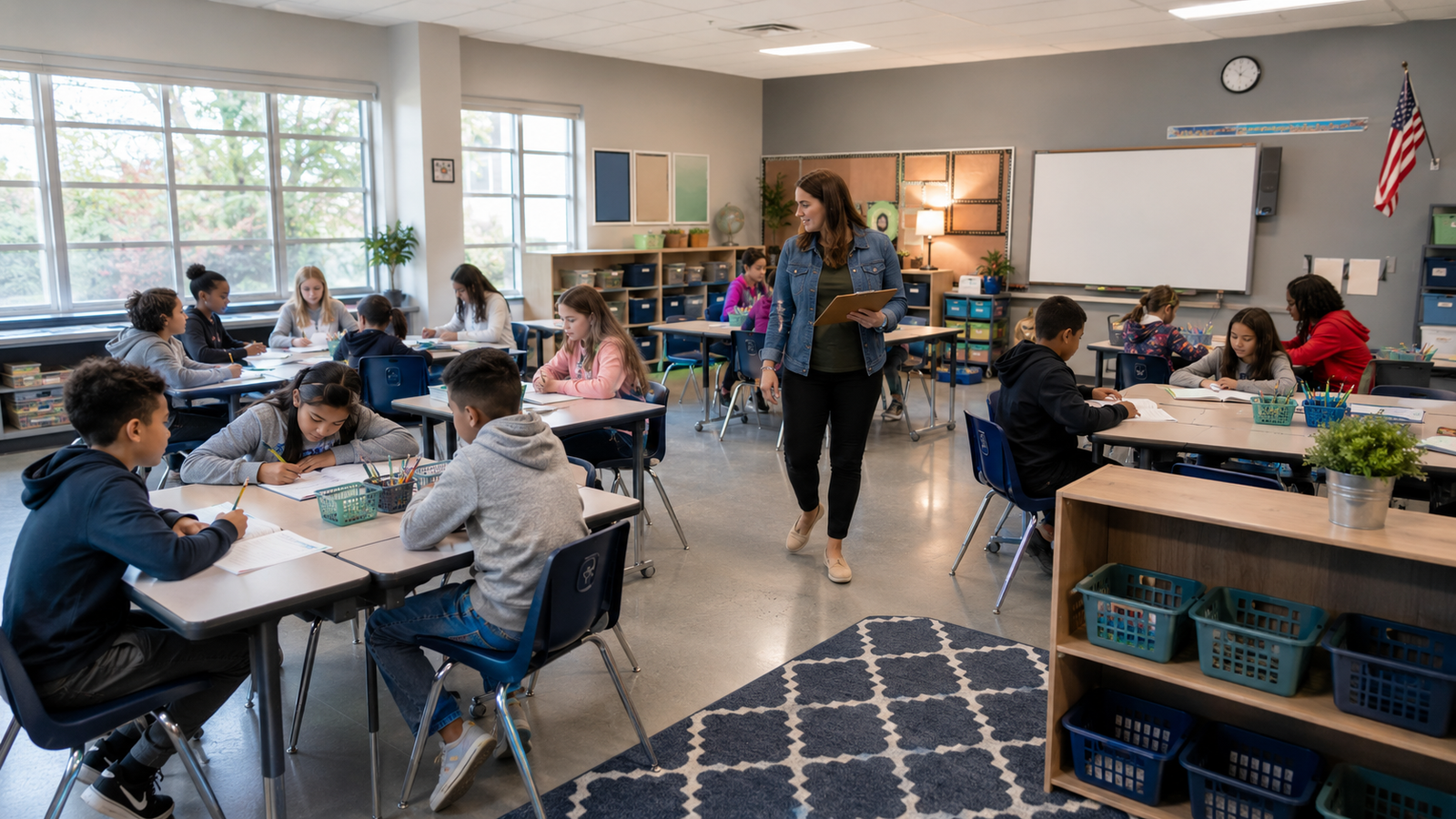
Classroom Management Strategies for Teachers
Effective classroom management is not about keeping every student silent or controlling every movement. It is about creating a room where students know what to do, learning can continue, and problems are handled without turning every correction into a confrontation. The strongest classroom management strategies are usually the ones students barely notice: clear expectations, practiced routines, purposeful lessons, calm responses, and fair follow-through.
I learned that lesson quickly. After student teaching and graduation, it took approximately 40 minutes as a middle-school substitute to convince me that I still had a lot to learn about managing the behavior of 30 students. Advice that sounded simple in a college classroom became much harder when directions, materials, personalities, time pressure, and unexpected behavior all collided at once.
This guide is meant for that real classroom. It combines prevention, practical classroom management techniques, and a clear response plan for the moments when prevention is not enough. Use the ideas as a starting point, then adjust them for your students, grade level, school policies, and teaching style.
If one classroom problem keeps repeating and you are not sure what to try first, use the Classroom Behavior Troubleshooter to narrow the likely driver and choose a practical first response.
Current evidence supports that emphasis on teaching and prevention. The What Works Clearinghouse’s K–5 behavioral-interventions guide recommends explicitly teaching expectations, reminding students of expected behavior, acknowledging it, offering appropriate choices, creating frequent opportunities to respond, and helping students monitor behavior. For the broader K–12 picture, the CDC’s classroom-management synthesis connects behavior management with teacher support, peer connection, student autonomy, social dynamics, and high expectations. These are guides to informed judgment, not a promise that one script will work for every student or grade.
Free Classroom Management Plan Template
Use this template to plan expectations, routines, prevention, responses, communication, and follow-up before problems occur, so your classroom-management decisions are ready when you need them.
Download the Classroom Management Plan (PDF)
Download the Editable Classroom Management Plan (Word)
What Effective Classroom Management Actually Means
A well-managed classroom is predictable, respectful, and focused on learning. Students understand the boundaries, but they also understand the purpose behind them. They know how to enter, begin work, ask for help, move between activities, work with classmates, and finish the period. The teacher does not have to improvise a new response every time something goes wrong.
Classroom management and discipline are related, but they are not identical. Management is the complete system that makes productive behavior more likely. Discipline is one part of that system: how the teacher responds when behavior crosses a boundary. If discipline is the only visible part of a plan, the classroom will feel reactive. A better system balances three kinds of work:
- Preventive: Teach expectations, organize the room, plan engaging instruction, and remove predictable trouble spots.
- Responsive: Correct behavior calmly, briefly, and at the lowest effective level.
- Restorative: Help students repair harm, rejoin the class, and practice a better choice.
The goal is not a perfect classroom. The goal is a classroom that can recover quickly and keep learning.
Some restorative and relationship skills need to be taught before conflict occurs. The guide to using social-emotional learning in ordinary classroom routines offers short, non-therapeutic ways to practice listening, self-management, disagreement, and repair.
Prevention Before Correction
The best time to solve many behavior problems is before they begin. Prevention does not mean lowering expectations or ignoring poor choices. It means designing the day so students have fewer chances to become confused, bored, embarrassed, or idle.
Look for predictable friction points
Think through the parts of a lesson where behavior usually slips: entering the room, waiting for materials, choosing partners, moving to groups, logging in, finishing early, or packing up. Each repeated problem is information. Instead of asking only, “Why are they doing this?” also ask, “What does my current procedure allow or require students to do at this moment?”
For example, if six students crowd around one supply bin, separating materials into two locations may prevent more disruption than a lecture about responsibility. If early finishers wander, a posted “When you are finished” routine removes the empty time that invites off-task behavior.
For a repeated movement problem, the Transition Routine Builder can help turn that friction point into a routine for the signal, route, materials, first task, and reset.
Prepare for difficult situations
Lesson preparation matters, but so does response preparation. What will you do if a student says an assignment is stupid? What if one student targets another? What if a student refuses to move, the class laughs during a correction, or technology fails with 20 minutes left? You do not need to obsess over every possible problem, but a few planned responses keep you from making important decisions while frustrated.
Write down your first response, the next step if the behavior continues, and the point at which school support is required. Check that the plan fits school policy. Preparation makes it easier to stay calm and reduces the temptation to send every challenge to the office.
Teach Expectations, Routines, and Procedures
Rules describe boundaries. Procedures explain how the classroom works. “Respect others” is an expectation; how students enter a discussion, disagree with a classmate, or get the teacher’s attention are procedures. Students need both.
Keep broad expectations few enough to remember, then teach the routines that make those expectations visible. A practical starting set might be: be safe, be respectful, be ready, and allow others to learn. The exact wording matters less than the examples, practice, and follow-through.
| Classroom moment | Procedure to teach | Clear teacher language |
|---|---|---|
| Entering class | Where to go, what to take out, and what to begin | “Enter, pick up the handout, and start the question on the board.” |
| Getting help | What to try first and how to signal | “Reread the example, ask your partner quietly, then place the help card upright.” |
| Partner talk | Voice level, turn-taking, and stopping signal | “Use a table voice. Each person explains one idea. Stop when my hand goes up.” |
| Materials | Who gets them and where they return | “The materials manager collects one tray and returns it before cleanup ends.” |
| Finishing early | Approved next choices | “Check your work, complete the extension, or read from your independent book.” |
| End of class | Cleanup and dismissal | “Put materials away, check your area, and remain seated until dismissal.” |
Model, practice, and reteach
Do not treat procedures as announcements. Show students what the routine looks and sounds like, let them practice it, give brief feedback, and try again. This is especially important at the start of the year, after a long break, when the schedule changes, or whenever the class shows that the routine is not secure.
Reteaching is not a punishment. A calm “That took longer than we need; let’s reset and practice it once” is more useful than a five-minute speech. The routine should save more time than it takes to teach.
Be consistent and fair without becoming rigid
Students should know what to expect from you. Set boundaries and consequences, then follow them as consistently as you reasonably can. Consistency does not require treating every situation as identical. Fairness means applying the same principles while considering age, context, student needs, and any required accommodations.
Do not play favorites. It can be difficult when a student who usually cooperates sits beside someone who challenges you every day, but students notice double standards quickly. Correct the behavior in front of you, not the reputation attached to the student. Explain exceptions privately when appropriate rather than inviting the class to judge another student’s circumstances.
For a broader look at establishing a strong start, the site’s review of The First Days of School connects classroom routines with the opening weeks of school.
Give Clear Directions Students Can Follow
Many apparent behavior problems begin as direction problems. Students cannot follow a procedure they did not hear or understand. Get attention before speaking, use concrete verbs, limit the number of steps, show the expected result when useful, and give a clear signal to begin.
A dependable sequence is:
- Get full attention before materials or movement begin.
- State the task in a few specific steps.
- Show where materials go or what finished work looks like.
- Ask a student to restate the first step or check for understanding.
- Give the start signal.
Instead of “Get ready for group work,” try: “When I say go, move to your assigned table, bring your notebook and pencil, and begin question one with a table voice. You have 20 seconds. What are you bringing? Good. Go.” The more complicated the task, the more helpful visible directions become. For scripts and examples, see The Ultimate Guide to Giving Effective Directions.
Manage Transitions, Pacing, and Dead Time
Transitions are short, but they can determine the tone of an entire lesson. A transition needs a destination, a movement path, a sound expectation, a time limit, and a signal. Give all directions before students move. Once they begin, monitor the transition instead of talking over it.
Use one repeatable transition routine
A simple routine might be: listen, repeat the task, move on the signal, begin the posted first step. Practice it when the class is calm. If the transition falls apart, stop only if it is safe and useful to do so, reset briefly, and practice again without sarcasm.
For a deeper treatment of movement and volume, use How to Fix Noisy Transitions in the Classroom.
Protect lesson pace
Dead time gives students a problem to solve for themselves, and the solution is often social. Have materials ready, post the opening task before students arrive, decide how papers will move, and prepare a short backup activity for technology trouble or an unexpectedly fast finish.
Pacing does not mean rushing. It means that students know what they are doing now and what comes next. Alternate listening with doing, break long explanations into smaller parts, and check understanding before confusion spreads. A two-minute reset, stretch, or partner check can restore attention better than pushing through a long block of passive time.
Use Student Engagement as Behavior Prevention
Developing your teaching skills belongs in a classroom management guide. When lessons are interesting, appropriately challenging, and active, many behavior problems become less likely. Students still need boundaries, but good instruction gives them a productive place to put their attention.
Plan for active participation
Do not rely only on volunteers. Build in quick writes, response cards, partner explanations, retrieval practice, brief movement, worked examples, or checks that require every student to think. Purposeful questioning techniques for teachers can turn a long explanation into a lesson students help build.
The site’s student engagement ideas offer additional ways to increase participation without turning every lesson into a game.
Match access and challenge
Work that feels impossible often produces avoidance; work that feels pointless or far too easy often produces wandering attention. Check whether a student understands the directions, has the needed prerequisite skill, can access the text or materials, and sees a manageable first step. Differentiated instruction can provide different routes or supports while keeping the learning goal clear.
Engagement is prevention, not a bargain in which students behave only when every activity entertains them. Some practice will be repetitive and some content will be difficult. The teacher’s job is to make the purpose clear, provide an entry point, and keep students actively connected to the work.
Build Relationships Without Giving Up Boundaries
Students are more likely to accept correction from an adult who knows them, notices their effort, and speaks to them with dignity. Learn names quickly. Greet students. Notice interests and strengths. Follow up after a difficult day. Give students a way back into good standing.
Warmth is not the same as permissiveness. A strong relationship can include a firm “I will not let you speak to someone that way.” Boundaries make relationships safer because students do not have to guess which version of the teacher will appear.
Correct privately whenever possible, and separate the student from the behavior: “You are welcome in this class. That choice is not acceptable. Here is what needs to happen next.” Avoid humor that embarrasses a student, public comparisons, or a running commentary about one child’s mistakes.
Respond Calmly to Minor Misbehavior
Use the least intrusive response likely to work. Most minor behavior does not need a public conversation. The longer and louder the correction, the more it can interrupt learning or give the student an audience.
- Pause and scan. Sometimes your presence and a moment of silence are enough.
- Use a nonverbal cue. Make eye contact, point to the posted direction, or use the class signal.
- Use proximity. Continue teaching while moving closer to the off-task student.
- Redirect briefly. State what the student should do: “Open to page 42 and begin number one.”
- Offer a limited choice. “You can work at this seat or the side table. Either way, the first two questions need to be finished.”
- Use a logical consequence. Connect the response to the behavior and the procedure that needs repair.
- Follow up privately. If the pattern continues, talk when neither of you is performing for an audience.
Make consequences logical and teachable
A logical consequence is related, respectful, and reasonable. A student who misuses materials may need to practice the materials routine or use a more controlled setup. A group that cannot work safely may need a temporary change in seating and another attempt after expectations are reviewed. A student who harms someone may need to repair the harm in a school-appropriate way.
Consequences should not be improvised to express anger. Know what you can enforce, avoid threats you cannot carry out, and follow school policy. The purpose is to protect learning and teach a better choice, not to win.
Avoid unnecessary public power struggles
Do not debate a direction across the room. State the expectation, give a reasonable choice when appropriate, and return attention to instruction. If a student tries to pull you into an argument, a quiet “We can discuss that after the class is working; right now, the direction is to begin” closes the public stage without pretending the student’s concern never matters.
Keep your voice slower and lower than the student’s. Give processing time. Do not crowd, corner, mock, or demand a public apology in the heat of the moment. You can be firm without matching the student’s intensity.
Respond When Behavior Escalates
When a student is escalating, the immediate goals are safety, reduced stimulation, and a path back to control. This is not the moment for a long explanation or a lesson about respect.
- Stay calm and use short, neutral sentences.
- Give physical space and avoid blocking an exit unless a trained safety plan requires otherwise.
- Reduce the audience by directing the rest of the class to a familiar task or following the school’s removal procedure.
- Offer one or two realistic choices rather than a string of commands.
- Call for designated support when safety, policy, or the student’s plan requires it.
- Save problem-solving and repair for a later time when the student is regulated.
Know your school’s crisis, bullying, threat, elopement, and emergency procedures before you need them. Document significant incidents factually: what happened before the behavior, what was observed, what actions were taken, who was notified, and how the situation ended. Avoid labels or guesses about motive.
Practical Responses to Common Classroom Problems
Talkative or noisy classes
First decide what volume the task actually needs. Silence is not automatically the goal. Teach a small set of usable volume levels, state the level before each activity, and use one attention signal that you will not talk over. Shorten the time between checks, separate high-traffic material areas, and reset a routine when the whole class shows it is unclear.
If only a few students are talking, correct those students rather than punishing the room. If the whole class is noisy during every transition, repair the transition system. Match the response to the pattern.
Off-task behavior
Off-task is a description, not an explanation. Quietly check the likely barrier: unclear directions, missing materials, task difficulty, distraction, social attention, fatigue, or no obvious first step. Then respond to the barrier while maintaining the expectation.
A useful prompt is: “Show me where you are stuck.” Follow it with a small restart: “Complete this first line. I’ll return in two minutes.” Proximity, a visual timer, a reduced set presented one part at a time, or a seat change may help. Do not turn a 30-second redirection into a ten-minute conversation during instruction.
Students who refuse or avoid work
Keep the interaction private and calm. Clarify whether the student cannot start, does not understand, fears failure, objects to the task, or is trying to escape a consequence. Acknowledge the concern without surrendering the learning expectation: “I hear that you do not want to do this. We still need a start. You may begin with number one beside me or begin with number three at your desk.”
Chunk the task, identify the minimum first step, provide an approved support, and schedule follow-up. Repeated refusal needs more than repeated demands; look for a pattern across tasks, times, settings, and supports, then involve the appropriate school team.
Group-work behavior
Do not assume students know how to collaborate. Define the product, time limit, roles, voice level, materials process, help routine, and individual accountability. Circulate early, not only after the noise rises. Stop briefly to highlight a group using the process well.
If a group fails, diagnose the procedure before abandoning group work. The task may be too vague, one student may control every decision, or there may be no reason for each person to participate. The site’s guide to collaborative learning can help you design group tasks with clearer participation structures.
Adjust Classroom Management by Grade Level
The principles stay similar across grades, but the presentation changes. Use the student’s developmental level, not a one-size-fits-all script.
Elementary school
Young students need routines broken into visible actions, frequent modeling, visual cues, and repeated practice. Teach how to sit for a meeting, move to a station, share supplies, and ask for help. Build movement into lessons rather than expecting long periods of stillness. Praise should name the useful behavior: “You put the materials away and started the warm-up right away.”
Middle school
Middle-school students want independence but still need structure. Keep directions concise, explain the practical reason for routines, and avoid anything that feels publicly childish. Peer attention is powerful, so private corrections and quick redirections are especially important. Offer bounded choices and predictable resets without turning every challenge into a test of authority.
High school
High-school management works best when procedures respect students’ growing autonomy. Be explicit about deadlines, device use, discussion norms, late arrivals, independent work, and help. Connect routines to learning time and shared responsibility. Do not mistake age for mastery; older students also need expectations taught and retaught, just with direct language and less performance.
Create a Practical Classroom Management Plan
A useful plan can fit on one or two pages. It should be clear enough that you can follow it on a difficult day and concrete enough that a substitute or colleague could understand the basics.
- Choose three to five broad expectations. Define what each looks like during instruction, independent work, discussion, and movement.
- List the routines you must teach. Include entry, attention signal, materials, help, transitions, group work, early finishing, devices, cleanup, and dismissal.
- Plan preventive supports. Note seating, visual directions, movement, lesson chunks, materials placement, and supports required by student plans.
- Create a calm response ladder. Nonverbal cue, proximity, redirection, choice, logical consequence, private follow-up, and school support.
- Decide how you will acknowledge success. Use specific feedback, positive contact home, privileges, or another age-appropriate system.
- Identify support routes. Know who handles academic concerns, behavior plans, counseling, special education, safety, bullying, and family communication.
- Set a review date. After two weeks, ask which problems are decreasing, which routines need reteaching, and which students need a more individualized plan.
Keep the plan teachable. A complicated point system with many exceptions can consume more attention than it saves. Start with a few routines and responses you can use consistently.
Use the downloadable Classroom Management Plan Template to capture these decisions in one place and revisit them as routines and student needs change.
Common Classroom Management Mistakes
- Correcting before teaching. Students cannot meet a procedure that exists only in the teacher’s mind.
- Talking while students are moving or talking. Get attention first, then give directions.
- Using vague commands. Replace “behave” or “settle down” with the action you want to see.
- Giving long public lectures. They stop learning, create an audience, and rarely teach the missing routine.
- Threatening consequences you cannot enforce. Use a smaller response you can follow through on.
- Changing the rules with your mood. Students should not have to test which boundaries exist today.
- Trying to be liked by avoiding boundaries. Warmth and limits can exist together.
- Focusing only on mistakes. A room feels negative quickly when the teacher notices only what is wrong.
- Treating every student or behavior as the same. Keep principles consistent while using required supports and relevant context.
- Assuming a consequence fixed the cause. If the behavior repeats, examine the task, routine, setting, skill, and support.
Catch Students Doing the Right Thing
Behavior management does not have to feel negative. A common trap for new or frustrated teachers is to focus so heavily on unwanted behavior that the whole room begins to feel like a list of corrections. Notice the behavior that protects learning: a quick start, a respectful disagreement, a repaired mistake, a group that includes everyone, or a student who gets back to work after redirection.
Something as simple as a sticker can motivate students, even some middle- and high-school students. The idea reminded me of the 1979 Pittsburgh Pirates. During their “We Are Family” championship season, team captain Willie Stargell gave players Stargell Stars for exceptional performances, and they wore the stars on their caps. If recognition could matter to professional players, there is at least a chance that a small, visible acknowledgment will matter to students.
Use rewards thoughtfully. Name the behavior rather than praising a fixed trait, avoid systems that publicly shame students with fewer points, and do not make every responsible action depend on a prize. Recognition should help students notice and repeat productive choices; it should not replace relationships, meaningful work, or clear expectations.
When Classroom Strategies Are Not Enough
Some behavior will not improve through ordinary routines, redirection, or consequences alone. Seek additional support when behavior creates a safety concern, involves bullying or threats, shows a serious or persistent change, prevents the student or class from accessing instruction, or continues across settings despite consistent support.
Also involve the appropriate team when a student has an IEP, 504 plan, behavior intervention plan, safety plan, or another documented support that applies. Follow those plans and school procedures. A teacher should not diagnose a student, ignore required accommodations, or design a high-stakes intervention alone.
Bring useful information to the team: when and where the behavior occurs, what usually happens before it, what the student does, how long it lasts, what has been tried, and what helps. Partner with families, administrators, counselors, special educators, behavior staff, or other designated professionals. The guide to building a useful home-school connection explains how to prepare for a concern, listen for context, document facts, and keep the student at the center. Asking for support is not giving up classroom authority; it is using the system students may need.
For a candid example of why some challenges require school-level support as well as classroom practice, read what teaching in one Title I school was actually like.
A Classroom Management Checklist for Tomorrow
- Post a short task students can begin immediately.
- Choose one attention signal and use it consistently.
- Give directions before distributing materials or allowing movement.
- State the voice level and time limit for each transition.
- Plan one way every student will participate.
- Identify the first low-key response you will use for minor behavior.
- Decide what logical next step follows if redirection does not work.
- Notice at least three specific examples of students supporting learning.
- Follow up privately with a student who struggled.
- At the end of the day, adjust one routine instead of blaming the entire class.
Every class has its own qualities, and a classroom management strategy that works beautifully in one room may need adjustment in another. Keep the parts that make expectations clearer, protect dignity, and increase learning time. Reteach what is not secure. Ask for help when the pattern is bigger than one teacher can solve.
For more ways to plan instruction that keeps students thinking and participating, explore the Instructional Strategies List for Teachers.
Sources and Further Reading
- What Works Clearinghouse. Teacher-Delivered Behavioral Interventions in Grades K–5.
- Centers for Disease Control and Prevention. Classroom Management Approaches.
