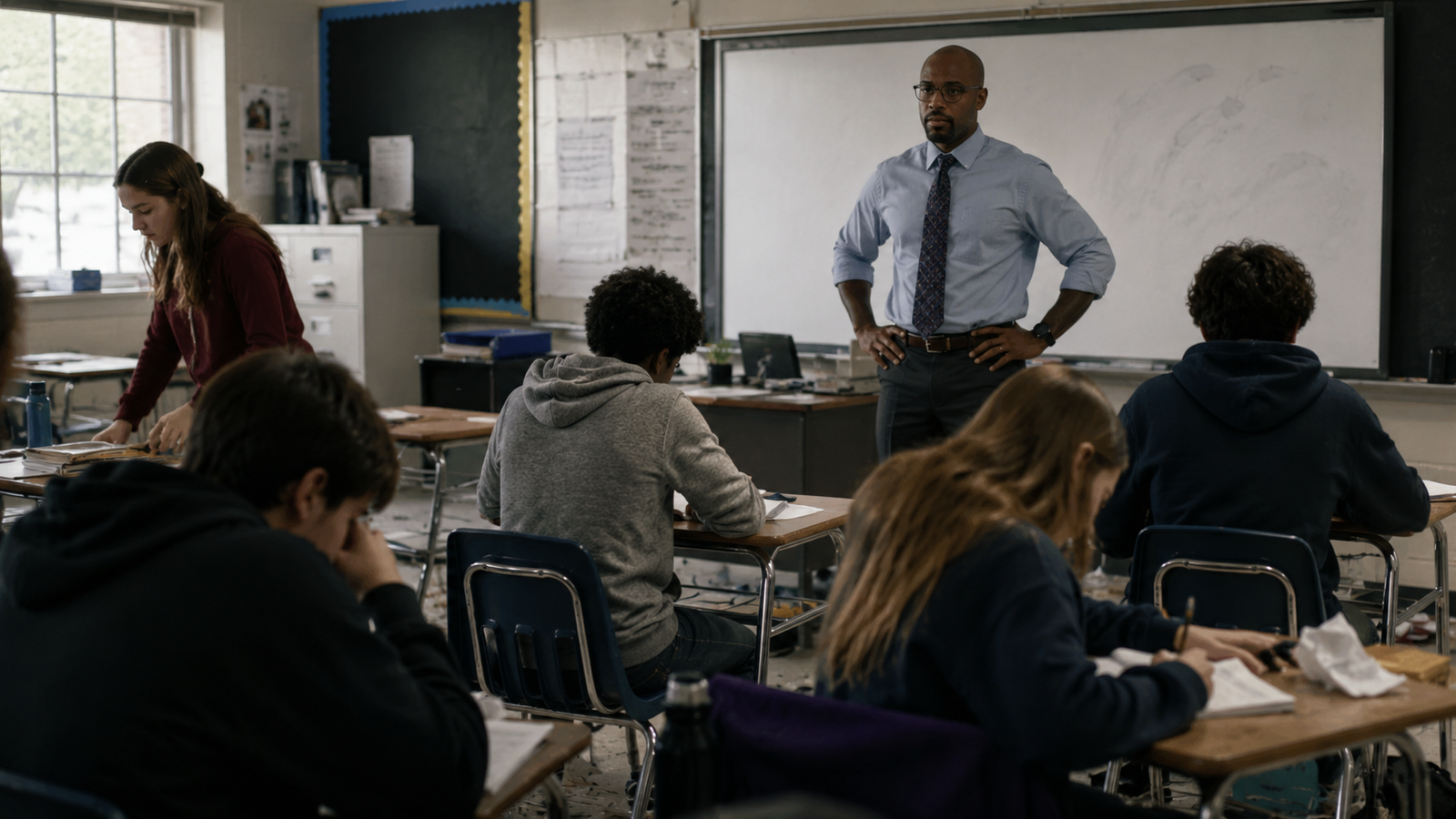
How to Regain Control of a Classroom That Has Gone Off the Rails
You are not reading this because one transition ran long. You are reading it because the room feels as if it has slipped out of your hands. Students talk through directions. Materials move before you finish speaking. The same conflicts restart. You spend more time correcting than teaching, and the corrections are no longer changing much.
Start by admitting something practical: the current system is not working. That is not the same as saying you are a bad teacher or that every problem is your fault. It means the routines, responses, environment, instruction, or support around this class are not producing a room where learning can continue. You need a reset, not a longer speech about respect.
You can regain control of a classroom, but not by trying to control every movement at once. The first goal is smaller: make the next day safer, clearer, and more teachable than the last one.
Describe What “Out of Control” Actually Means
“My class is out of control” is a real feeling, but it is too broad to guide your next move. Translate it into behaviors another adult could see or hear:
- Students continue side conversations while you give directions.
- Students leave their seats during independent work.
- Materials create crowding, arguments, or long waits.
- A transition takes eight minutes or becomes unsafe.
- Several students call out, but the same two restart the pattern after every correction.
- Unsafe language, threats, physical conflict, or leaving the room interrupts instruction.
Record what happens, when it happens, and how often. Write “continued talking during three explanations after a reminder,” not “disrespectful.” Specific descriptions reveal patterns and make requests for support more useful.
A classroom-management summary from the Institute of Education Sciences (IES) recommends identifying the behavior and examining what precedes and follows it. A blanket response can miss the cause—or keep the pattern going.
Pick the One to Three Problems Costing the Most
Choose one to three priorities based on safety and lost learning time: listening during directions, moving safely through a transition, or beginning the posted task within two minutes. Let minor annoyances wait. Twenty new rules create twenty new opportunities for inconsistency.
For each priority, decide:
- What should students do instead?
- What usually happens before the breakdown?
- What will I do the first time and when it continues?
- When does school support become necessary?
Whole-Class System or the Same Few Students?
This distinction changes the intervention.
If most students struggle in the same moment, inspect the system. Directions may be too long. Materials may require unnecessary movement. Students may wait with nothing to do. The task may have no visible entry point. A transition may depend on five verbal steps that disappear as soon as chairs move.
If the class responds but the same few students keep derailing it, stop repeatedly punishing everyone. Address those students individually. Track when and where the behavior occurs, what happens immediately before it, your response, and what the student gains or avoids afterward. Look for patterns across subjects, times, peers, and task types.
Gather enough information to choose a response that fits the pattern rather than guessing a student’s motive. The IES summary notes that an intervention tailored to a specific behavior is more effective than a blanket response disconnected from the problem.
If sustained talking is the central issue, the more focused guide Students Won’t Stop Talking While I’m Teaching separates an attention-signal problem from the deeper expectation of listening while someone else has the floor.
Reset the Environment Before You Lecture the Class
Some disorder is built into the room. Fix what you can before asking students to compensate for a weak setup.
Seating and supervision
Move seats when the current arrangement repeatedly produces conflict, social performance, or spaces you cannot monitor. You do not need to pretend a seating change solves the underlying behavior. It can make the behavior less easy to restart while you work on the larger problem.
Traffic and materials
Separate crowded supply points. Put commonly used materials where students can get them without crossing the entire room. Assign who collects and returns shared items. Give directions before students touch materials.
Transitions
Every transition needs a destination, route, sound level, material plan, time boundary, and first action. Use the Transition Routine Builder to put those pieces into one routine. For a fuller treatment, see Noisy Transitions.
Waiting and early finishers
Waiting is not neutral. Students who finish early or wait while you troubleshoot will find something to do, and it may not be your preferred activity. Post a short approved next step: check the work, begin the extension, read, or complete a defined independent task.
Unclear procedures
“Get ready,” “settle down,” and “work appropriately” leave too much interpretation. Use the Direction Clarity Checker and Giving Effective Directions to shorten the language and make the first action visible.
The broader Behavior Management guide can help you connect routines, instruction, correction, consequences, and support instead of treating discipline as a series of isolated reactions.
Explicitly Reteach Concrete Expectations
Teach each priority routine in observable language: name when it applies, state the actions, give a quick example and nonexample, practice briefly, and provide feedback.
Instead of “Transitions need to improve,” try: “When the timer sounds, close the document, carry only your notebook, move directly to your assigned table, and begin the posted question with a table voice.”
The December 2024 What Works Clearinghouse practice guide rates teaching clear expectations, reminders, and acknowledging expected behavior as supported by strong evidence. It rates frequent and varied opportunities to respond as supported by moderate evidence. Those ratings apply specifically to grades K–5. The practices can inform decisions in older grades, but the K–5 evidence ratings should not be presented as if they automatically apply to middle or high school.
Precorrect Before the Moment That Usually Breaks
A precorrection is a brief reminder before a predictable problem situation.
Before independent work: “The first two minutes are silent. Begin with the example on the board. If you are stuck, circle the step and use the help signal.”
Before materials move: “No one stands yet. The table manager collects one tray when I say go. Everyone else begins the first question.”
Keep it short enough to remember, then monitor as the situation starts.
Follow Through With Consequences You Can Enforce
A reset without follow-through becomes another speech students learn to wait out.
Tell students the first response and the next response. Use the least intrusive action likely to work, but do not keep repeating the same reminder when it clearly is not working.
A practical sequence might be:
- Brief redirection to the expected action.
- Seat, material, group, or participation change if the disruption continues.
- A private follow-up and completion or repair connected to the behavior.
- The documented school response for repeated or serious disruption.
- Team support when the classroom response is not enough.
Consequences should be clear, proportionate, realistic, and consistent with school policy and any applicable student plans. A teacher may move a student to a different working location, have a student complete a missed routine correctly, arrange for interrupted work to be finished during an appropriate school-approved time, or require reasonable repair for disruption to materials or classmates. Use only responses you are authorized to enforce. Do not promise that “the office will handle it” when you know the response is uncertain. Weak or inconsistent administrative follow-through is a system problem, and pretending otherwise does not help teachers or students.
Trauma-sensitive guidance from REL Appalachia recommends clear limits, logical consequences, predictable routines, calm and solution-oriented responses, and reasonable, fair discipline. Trauma sensitivity does not mean removing every boundary or replacing consequences with rewards. It means avoiding humiliation, threat, and unnecessarily punitive responses while maintaining safety and a path back to learning.
Reduce Teacher Talk and Increase Active Responding
Break explanations into short chunks. After a key idea, have every student write, point, solve, retrieve, vote, compare, or explain. A visible response gives students something productive to do and shows who is following.
The IES classroom-management summary includes active engagement and increased opportunities to respond among its five strategies. The current WWC guide gives moderate evidence support to frequent and varied opportunities to respond in K–5 classrooms.
Long teacher monologues create more opportunities for attention to drift; they do not excuse disruption. For practical participation structures, see Student Engagement.
When the Same Few Students Keep Derailing Class
If two or three students repeatedly restart the disorder, keep a simple one-week record:
- time, activity, and exact behavior;
- what happened immediately before it;
- how adults and peers responded;
- what happened next.
Look for useful patterns: a particular task, peer, public correction, time of day, or difficulty beginning the work. Then respond at the right level with adjusted seating, clearer task access, a targeted skill, a private plan, a family conversation, or formal support. Hold the boundary without making the entire class pay for a pattern driven by a few students.
When Other Adults Need to Become Part of the Solution
One teacher cannot independently solve every chronic, unsafe, disability-related, mental-health, family, staffing, or schoolwide problem.
- Colleagues: Ask a trusted teacher to observe a specific period and record what happens before the breakdown. Compare what works with the same students elsewhere.
- Specialists: Involve special education staff, counselors, behavior specialists, school psychologists, or student-support teams when patterns suggest needs beyond a general classroom reset.
- Families: Share neutral facts, ask what they have noticed, and agree on one realistic next step. Avoid opening with a character judgment.
- Administration: Ask for a concrete response: observation, coverage, enforcement of a safety procedure, a reentry plan, a team meeting, or support during a predictable high-risk period.
Good administrators reduce isolation, respond to safety concerns, make expectations across adults clearer, and help coordinate support. Weak support can make an already difficult class harder. A teacher should not be told to “build relationships” harder while serious disruption continues without a workable team response.
The IES summary explicitly recommends leaning on colleagues and families when chronic or serious behavior is difficult to manage. REL Appalachia also advises educators to understand referral procedures, seek appropriate professional support, and develop individualized support or safety plans when needed.
If the problem is larger than classroom technique—unclear curriculum, unsafe conditions, inconsistent policies, inadequate staffing, or unsustainable workload—the New Teacher Survival page helps separate what you can change tomorrow from what requires structural help.
What a Classroom Reset Should NOT Become
- Yelling louder. Volume may startle students briefly. It does not create a durable routine.
- Humiliation. Publicly embarrassing a student creates an audience and makes repair harder.
- A power struggle across the room. State the direction, give the next action, and follow up privately when possible.
- Twenty new rules. Choose the few actions protecting the most safety and learning.
- Gimmick-shopping. A new signal, app, prize wheel, or behavior chart cannot replace an expectation you teach and enforce.
- “Just build relationships.” Relationships matter, but that phrase is not a response plan for a class where instruction is repeatedly derailed.
- PBIS as a magic label. Explicit teaching, reminders, acknowledgment, and data can be useful. A branded system or points alone will not repair weak routines, inaccessible instruction, inconsistent consequences, or missing support.
- Rewards-only advice. Recognition can clarify what is working. Students also need boundaries and predictable consequences when behavior continues.
The 48-Hour Classroom Reset Plan
Before the next class
- Name the pattern: Write the observable behaviors, not labels.
- Choose one to three priorities: Start with safety and the largest loss of learning time.
- Repair the setup: Change seating, materials, traffic, waiting, directions, or the first task where needed.
- Write the routine: Define what students do, your first response, the next consequence, and the point for additional support.
During the next class
- Explain the reset briefly: “The current pattern is costing us too much learning time. We are resetting three routines today.”
- Teach and practice each priority: Model it, rehearse it briefly, and give students the immediate next task.
- Precorrect before the hard moment: Remind students what to do before materials, movement, discussion, or independent work.
- Follow through: Do what you said you would do without adding a public argument.
After class and on day two
- Review what changed: Which routine improved, where did the class still break down, and who drove the remaining problem?
- Keep what worked: Do not switch systems because the first day was imperfect.
- Target the remaining pattern: Use individual tracking for the same few students rather than restarting the whole-class reset indefinitely.
- Escalate when the reset is not enough: If unsafe behavior or major disruption continues, document the pattern and initiate a specific response with the appropriate colleagues, specialists, families, and/or responsive administration. Do not repeat the same reset indefinitely.
Regaining control does not mean creating a silent room where no one takes a risk. It means students can tell when to listen, when to talk, how to move, how to begin, and what happens when a boundary is repeatedly crossed. It means you can teach without improvising every response while frustrated.
You do not have to repair the entire year in 48 hours. You do need a clearer next class than the last one.
