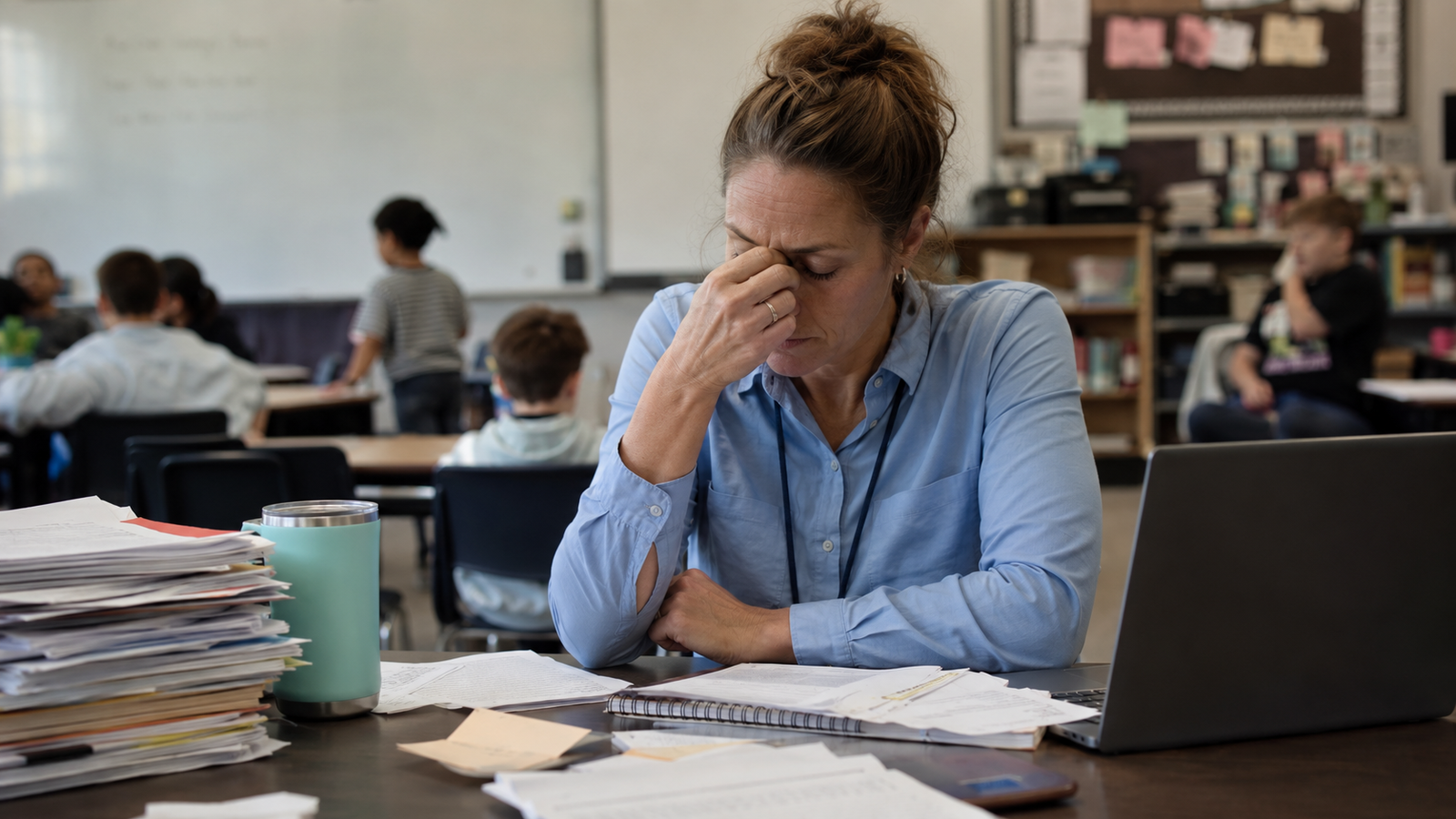
Why Teaching Feels So Much Harder Than “Every Job Sucks”
Every job has hard parts. I know that. Most teachers know that. In fact, a lot of teachers have worked plenty of other jobs before they ever stepped into a classroom. Retail. Restaurants. Offices. Warehouses. Summer jobs. Night jobs. Jobs where customers were rude, managers were clueless, schedules were unfair, and the pay was not nearly enough.
So when someone says, “Yeah, but every job sucks,” I do not think they are completely wrong. I just think they are missing the point.
The problem with teaching is not simply that it is difficult. The problem is that teaching has become a job where the actual teaching is often pushed to the side by everything else. You are hired to teach children how to read, write, solve problems, think critically, explore science, understand history, make music, create art, or grow as human beings. Then you spend enormous parts of the day managing behavior, documenting behavior, answering emails, covering gaps, calming emotions, adjusting to new mandates, preparing for tests, responding to parents, and trying to keep a room full of children safe, focused, and moving in the same general direction.
 It is hard to explain that to someone who has not lived it. In most jobs, the hard part is doing the work. In teaching, the hard part is often getting enough space, time, support, and cooperation to do the work at all. That is a very different kind of exhausting.
One thing people outside the classroom often underestimate is how little mental downtime teachers get during the school day. There is no easing into the morning. No checking your email while sipping coffee and slowly organizing your thoughts. No quiet twenty minutes to get settled. Once the students are there, you are on.
You are watching the lesson, the clock, the student who looks confused, the student who is quietly doing nothing, the student who is about to bother someone, the student who needs help but will not ask, the student who has an accommodation, the student who forgot a pencil, the student who suddenly needs the bathroom, the student who looks like they might cry, and the student who is sharpening a pencil for the fourth time because it is easier than doing the assignment.
And while you are watching all of that, you are also trying to teach.
That part is hard to describe without sounding dramatic, but it is real. A teacher’s brain rarely gets to sit down during the day. Even during planning time, if you get it, there are copies to make, emails to answer, data to enter, lessons to adjust, meetings to attend, papers to grade, and problems from earlier in the day that still need to be handled.
Even lunch often does not feel like lunch. Sometimes it is twenty minutes. Sometimes it is interrupted. Sometimes you are eating while answering a student question or talking to another teacher about a problem that cannot wait.
By the time a teacher gets home, the brain is not just tired. It is overused. That is why a simple question like, “What do you want for dinner?” can feel strangely impossible. It is not really about dinner. It is about having made hundreds of small decisions all day long and not wanting to make one more.
Every generation has complained about student behavior, so it is easy for people to dismiss this part. But teachers know the difference between normal childhood immaturity and constant disruption that makes learning nearly impossible.
Kids talk. Kids wiggle. Kids forget directions. Kids test limits. That has always been true. But when misbehavior becomes constant, when consequences are inconsistent or nonexistent, when a few students can derail the learning of an entire room, and when the teacher is blamed for not magically fixing it all, that is something else.
Teachers are often told to build relationships, make lessons more engaging, differentiate more, call home more, document more, redirect more, give grace, stay calm, and try another strategy. Some of that advice is good. Relationships matter. Engagement matters. Calm matters. But none of those things replace a functioning system.
A teacher can have a wonderful lesson prepared and still spend half the period dealing with refusal, interruptions, disrespect, side conversations, phones, arguments, or students who simply will not allow the room to settle. Then, if the lesson does not go well, the teacher is still the one held responsible.
That is one of the great frustrations of teaching: the teacher is judged by outcomes they can influence but not fully control. If a student refuses to work, that becomes the teacher’s problem. If a student fails, that becomes the teacher’s problem. If behavior destroys the lesson, that becomes the teacher’s problem. If parents are upset, that becomes the teacher’s problem. If administration does not follow through, somehow that still becomes the teacher’s problem.
That wears people down.
One of the most frustrating parts of teaching is being responsible for things you do not actually have the authority to control. Teachers are responsible for student learning, but they cannot make students care. Teachers are responsible for classroom behavior, but they may not be allowed to enforce meaningful consequences. Teachers are responsible for communication, but they cannot make families respond.
Teachers are responsible for accommodations, interventions, enrichment, remediation, emotional support, safety, documentation, and academic growth, but they are still one person in a room with twenty, twenty-five, thirty, or more students.
And every student arrives with a different story. Different skills. Different needs. Different home lives. Different motivation levels. Different learning gaps. Different personalities. Different triggers. Different parent expectations.
The teacher is supposed to meet all of those needs while keeping the whole class moving forward. That is not laziness. That is not complaining. That is math. There are only so many minutes in a period. There is only so much attention one adult can divide. There is only so much emotional energy one human being can spend before something starts to break.
Even taking a day off can feel like more work than showing up. In many jobs, when you are sick, you call off. Maybe you send a message. Maybe you set an out-of-office reply. Teaching is different.
A teacher who is sick still has to think about the room, the plans, the copies, the seating chart, the student who cannot sit near another student, the class that can handle independent work, the class that absolutely cannot, the emergency drill, the student with medical needs, the student who will claim they “didn’t know what to do,” and the possibility that nothing gets done and tomorrow’s lesson is now ruined too.
Sub plans are their own kind of unpaid labor. And when you return, you do not return to a clean pause in the workflow. You return to whatever happened while you were gone. The work does not stop because you were absent. It waits for you.
That is one reason teachers come to school sick, tired, grieving, stressed, and burned out. Sometimes it truly feels easier to drag yourself in than to prepare for being gone. That is not healthy, but it is common.
People often talk about teaching as if it is mainly delivering information. It is not. Teaching is emotional work.
You are managing the emotional temperature of the room all day. You are encouraging one child, correcting another, calming another, challenging another, and trying not to take it personally when a student is rude, dismissive, or cruel. You are trying to be firm without being harsh, warm without being a pushover, flexible without losing structure, and patient when your patience has already been spent.
You absorb a lot. You hear things from children that stay with you. You see needs you cannot fix. You notice who is hungry, who is lonely, who is angry, who is anxious, who is pretending not to care because caring feels too risky.
And then, at the same time, you may be getting criticism from adults who think they understand the job because they once sat in a classroom.
Almost everyone has been a student, so almost everyone thinks they understand teaching. But being a student is not the same as running the room. Watching a teacher is not the same as being responsible for every child in front of you. Having opinions about schools is not the same as carrying the daily weight of one.
This is another strange part of the job. Teachers are expected to be highly trained professionals. They need degrees, certifications, continuing education, professional development, data knowledge, classroom management skills, content knowledge, technology skills, communication skills, and emotional intelligence.
But they are often treated as if they cannot be trusted. They may be micromanaged over lesson plans, pacing guides, bulletin boards, classroom procedures, test data, email wording, and professional development requirements that have little connection to the actual needs in the room.
They are told to be creative, then handed scripts. They are told to differentiate, then given rigid timelines. They are told to build relationships, then given overcrowded classes and no time. They are told to take care of themselves, then handed more tasks. They are told their work matters, but their planning time disappears.
It creates a kind of professional whiplash. Be an expert, but do not make too many decisions. Be responsible, but do not expect authority. Be compassionate, but do not get overwhelmed. Be excellent, but do it with fewer resources each year.
No wonder so many teachers are tired.
I do not want to pretend teaching is only misery. It is not. There are moments that are genuinely beautiful. A student finally understands something. A quiet child starts to trust you. A class discussion goes somewhere unexpected. A former student comes back to say thank you. A kid who struggled all year has a good day and you get to witness it.
Those moments matter. For many teachers, those moments are why they stayed as long as they did. But meaningful moments do not automatically make a job sustainable.
That is where the public often gets confused. They hear teachers talk about burnout and respond with reminders about the importance of the work. Teachers already know the work is important. That is part of why it hurts.
It is painful to care deeply about a job while feeling like the system makes it harder and harder to do that job well. It is painful to know what students need and not have enough time, support, or resources to give it to them. It is painful to be told to “remember your why” when your “why” is not the problem.
The problem is the pile of everything else.
So, is teaching worse than every other job? I do not think we need to win that argument. There are many hard jobs. Nurses, social workers, first responders, service workers, caregivers, and many others deal with stress that deserves respect. Pain is not a competition.
But teaching has its own particular kind of exhaustion. It is the exhaustion of being responsible for children’s learning, safety, behavior, emotions, and progress while being given limited control over the conditions that shape all of those things.
It is the exhaustion of being watched, judged, interrupted, questioned, and second-guessed. It is the exhaustion of never being truly finished. It is the exhaustion of trying to do meaningful human work inside a system that too often runs on paperwork, pressure, and wishful thinking.
So when someone says, “Every job sucks,” I understand what they mean. But teaching does not just “suck” because it is work.
Teaching becomes unsustainable when the teacher is no longer allowed to simply teach.
And that, more than anything, is what people outside the classroom need to understand.
